
The ride home
Nov 04, 2026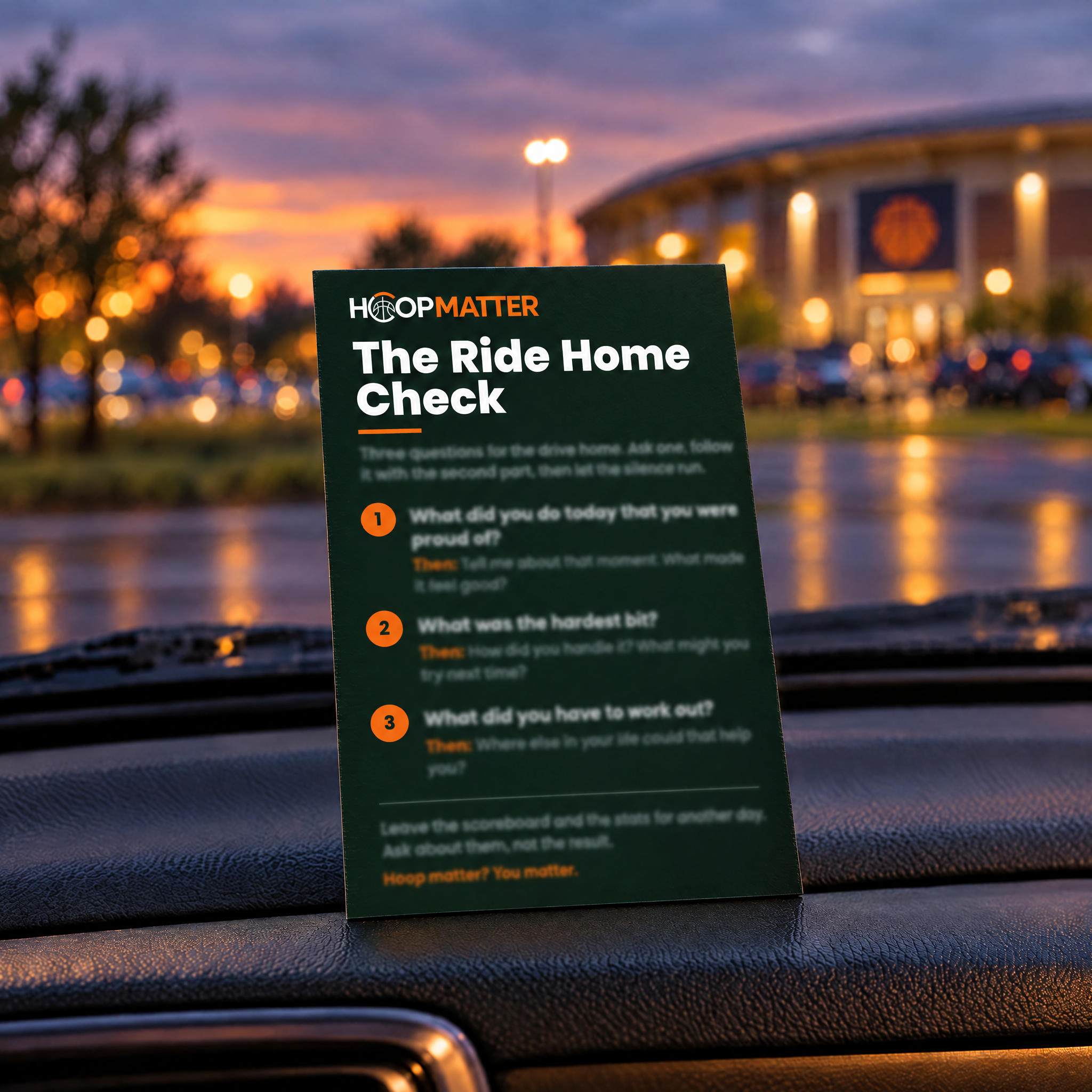
What really happens in the car after the game, and what to say instead
The final buzzer goes. Your kid packs their bag, finds the car, shuts the door. For the next twenty minutes it is just the two of you, a dashboard, and whatever happened on court.
For some young players that drive is the best part of the weekend. For others it is the part they dread most. Researchers have now spent close to a decade looking inside that car, and what they found is worth knowing before Saturday.
Where the research started
The late Katherine Tamminen, a sport psychologist at the University of Toronto, came to this topic through an athlete. While consulting at a hockey academy, a young player told her the most stressful part of sport was not the game. It was the car ride home (University of Toronto, 2026).
In her first study, Tamminen and colleagues interviewed 27 athletes aged 11 to 16 and their parents, separately, about those drives (Tamminen et al., 2017). The headline finding was that there is no single "car ride home". Some kids looked forward to debriefing. Others described it as something to endure, and a few admitted pretending to fall asleep to avoid the conversation.
The car itself matters. It is private, so parents often saved criticism for the drive to avoid embarrassing their child in front of teammates. That same privacy meant some conversations got sharper than they would have in public. On the other hand, sitting side by side rather than face to face made some kids more willing to talk (Tamminen et al., 2017).
What the cameras showed
Interviews tell you what people remember. So in a follow-up study the team put cameras in the car: 98 recorded drives from 28 parent and child pairs, about 30 hours of footage (Tamminen et al., 2022).
Three findings stand out:
- Most of the drive was quiet. Silence filled 59% of the time. Talk about sport filled only about 13%.
- Parents praised more than kids did. Parents gave more praise about the child's performance than the athletes gave themselves.
- Parents asked, then answered. Closed questions ("Was that a foul?") were the most common. Open, reflective questions were the rarest. In several cases parents jumped in before the child had a chance to reply.
That last point is the useful one. A British study of junior tennis players found the same pattern from another angle. Kids pulled back when a parent spoke as the expert on their game. When a parent asked a genuine open question about what the child wanted to work on, the conversation ran longer and warmer (Thrower et al., 2022).
The good news
The camera study did not find a car full of yelling parents. Most parents were supportive. The gap was smaller than that: well-meaning adults filling silence, asking questions with a right answer, and getting to the point before their kid did.
That is fixable.
Try this on Saturday
- Agree how the drive works, before the game. Tamminen's parents said simply talking about the car ride helped. Would your kid rather talk on the way home, after dinner, or not at all? Let them set the rules (Tamminen et al., 2017).
- Ask about them, not the result. Leave the scoreboard and the stats for another day. Start with something like "What did you do today that you were proud of?"
- Follow it with the second part. "Tell me about that moment." One open follow-up turns a one-word answer into a story, which is exactly what the tennis study found (Thrower et al., 2022).
- Then let the silence run. Quiet is not a problem to solve. It is often a kid processing. Count to ten before you fill it.
- Hand them the verdict. Your praise lands better after they have said what they thought of their own game.
Quiet is not a problem to solve. It is often a kid processing.
None of this means never talking about mistakes. Tamminen was clear that hard conversations have value. The aim is that your child never dreads getting in the car.
Get the Ride Home Check
The free Ride Home Check puts all of this on one card. Three questions, each with a follow-up: what they were proud of, what the hardest bit was, and what they had to work out. Ask one, follow it with the second part, then let the silence run. Grab it from the Matter Hub, keep it in the glovebox, and see what changes in a month.
Hoop Matter is an athlete development toolkit for basketballers aged 10 to 14. This post is general information, not individual advice.
References
Tamminen, K. A., Bissett, J. E., Azimi, S., & Kim, J. (2022). Parent and child car-ride interactions before and after sport competitions and practices: Video analysis of verbal and non-verbal communication. Psychology of Sport and Exercise, 58, 102095. https://doi.org/10.1016/j.psychsport.2021.102095
Tamminen, K. A., Poucher, Z. A., & Povilaitis, V. (2017). The car ride home: An interpretive examination of parent-athlete sport conversations. Sport, Exercise, and Performance Psychology, 6(4), 325 to 339. https://doi.org/10.1037/spy0000093
Thrower, S. N., Hamann, M., Stokoe, E., & Harwood, C. G. (2022). Examining parent-child interactions in British junior tennis: A conversation analysis of the pre-competition car journey. Psychology of Sport and Exercise, 60, 102166. https://doi.org/10.1016/j.psychsport.2022.102166
University of Toronto Faculty of Kinesiology and Physical Education. (2026). In memoriam: Professor Katherine Tamminen. https://kpe.utoronto.ca/node/5204
Matters Trio. Free.
Get the free Matters Trio and the Matter Hub every fortnight.
Unsubscribe any time. See our Privacy Policy.